
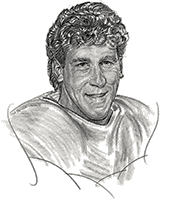
The son of Lakewood High School’s football coach was a good learner. So good that by the time he wound up an awesome career at neighboring St. Edward High in 1974 as an All-Ohio and All-American linebacker he had become one of the nation’s most coveted players. How coveted? On the night before the NCAA’s national letter signing day, three coaches gathered in the Cousineau home to do verbal battle for his signature. It was a gathering of legends: Bo Schembechler of Michigan, Joe Paterno of Penn State and Ohio State’s Woody Hayes. In a red letter day for the Scarlet and Gray, Hayes emerged a winner. Cousineau went on to win All-American honors in 1977 and 1978 (and a quarter-century later to be named the winner of the 2003 Butkus Silver Anniversary Award as the best linebacker in college football from 25 years ago). He would set an OSU season record with 211 tackles in 1978, take part in 29 tackles against Penn State, at the time another Buckeye mark with 16 solo tackles against Southern Methodist. At the end of his senior year he was selected by the Buffalo Bills, with the first pick in the 1979 NFL draft. Unable to reach a contract agreement, he opted to play for the Montreal Alouettes in the Canadian Football League where he became the Grey Cup MVP in 1979. The Bills traded his rights to the Cleveland Browns in 1983 and in five seasons with the Browns he led the team in tackles three times and was picked to two all-NFL teams. He ended his career with the San Francisco 49ers, retiring in 1987. In 2006, he announced his candidacy for a seat in the Ohio House of Representatives, won his primary and is currently Republican candidate for the seat.
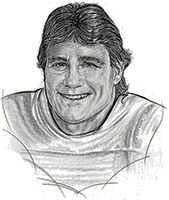
What was earning first team all-ACC honors as a middle linebacker at the University of Virginia worth to Dick Ambrose? Selection in the 12th round of the 1975 NFL draft by the Cleveland Browns. What was Dick Ambrose worth to the Cleveland Browns for the next nine seasons? Priceless. The 6-0 235-pounder—who earned the nickname “Bam Bam” which he carried through his career when he broke a pair of shoulder pads while making a tackle in his rookie season—became a starter early on and retained that status, starting 64 consecutive games, until a broken leg sidelined him in the sixth game of the 1983 season. He led the team in tackles for five consecutive years from 1977 to 1981, was named the team’s most valuable defensive player in 1977, was an integral part of the storied “Kardiac Kids” in 1980 (a team which wrote a special page in the Browns’ history), was voted the winner of the Browns’ Captains Award made annually to “a team player and an inspiration” in 1981, and was elected a team co-captain in 1982. He began studying law while still an active player, and received his degree from Cleveland State’s Marshall College of Law in 1987 and practiced law in Cleveland until he was appointed a judge of the Cuyahoga County Court of Common Pleas in 2004. The native of New Rochelle, NY, has remained active in a large number of civic, charitable and athletic affairs in Greater Cleveland and makes his home in Westlake.
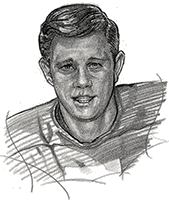
One of Greater Cleveland’s top high school athletes in the early ’60s, he climaxed a brilliant football career by quarterbacking St. Joseph High to a 9-0-1 record as a senior in 1963 to earn a spot on the All-Ohio team as selection as the area’s outstanding scholastic by the Cleveland Touchdown Club. Moving on to Notre Dame, he played quarterback as a sophomore, then was converted to safety for his final two seasons. As a defensive player, he gained All-American as a senior when he set several school records that were to stand for more than 25 years, including most interceptions returned for touchdowns and most yards gained on punt returns in a game and a season. He was drafted by the Cleveland browns in 1968, but a stint in the Army put his professional career on hold until 1970 when he put in one season with the Browns. After several years in the business world, he returned to St. Joseph as an assistant football coach in 1988. He became the Vikings’ head coach in 1995 and added the duties of the athletic director in 1998.
Deceased 2023
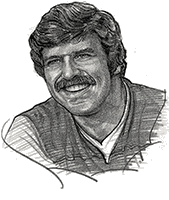
Inducted into the Pro Football Hall of Fame in 1999, he was born and raised in Cleveland, starred for the Cleveland Heights High football team, then went on to play for the University of Michigan’s 1964 Big Ten and 1965 Rose Bowl champions and to earn second team All-American recognition in 1965. A first round draft pick of the Los Angeles Rams in 1966, he played 13 seasons for the team at guard from 1966 to 1978, starting 176 of the 184 consecutive games he played, never missing a contest in his pro career. He was selected for 11 Pro Bowl games, a mark exceeded by only six players in NFL history, and to nine All-NFL first or second teams. Helped lead the Rams to eight division championships, including an NFL record six consecutive titles. Was team captain in his last four seasons. The son of Cleveland Indians second baseman and Case Tech football great Ray Mack, an early inductee into the GCSHofF, he became a vice president and regional executive for Bechtel Corp., the largest engineering and construction company in the United States, making his home in Las Vegas, NV.
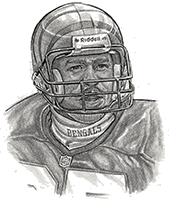
An Alumni Wall of Fame has been established within the halls of the beautifully renovated John Hay High School located at the edge of Cleveland’s University Circle. A check of the internet for a list of those honored reveals the surprising fact there is no one listed. Perhaps the Wall is just too new a feature. Or perhaps the keepers of the Wall do not recognize the alum who the school has listed in its records as Timothy Dwayne Hatchett when he was starring for the school’s football team in 1980 and 1981 before moving on to the University of Tennessee had blossomed into national stardom as Timothy Dwayne Hatchett McGee. That would be the Tim McGee who left Tennessee in 1985 as UT’s all-time leader in receptions, receiving yards and receiving touchdowns with a first team slot on the College Football All-American Team, the same Tim McGee who was selected in the first round of the 1986 NFL draft by the Cincinnati Bengals and became a major contributor there for eight seasons, leading the league in kickoff returns as a rookie, helping them to a Super Bowl championship in 1988 and enjoying his best personal season in 1989 with 65 receptions for 1,211 yards and eight touchdowns before joining the Washington Redskins for one season in 1993, then returning to Cincinnati for a final season before retiring. The strong candidate for the John Hay Alumni Wall of Fame now lives in the Cincinnati suburb of Mason and is the head basketball coach at Ursuline Academy.
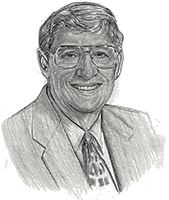
It has been almost 50 years now since he began making friends and influencing people on behalf of Cleveland sports organizations. Ask anyone in position to know and they’ll tell you nobody’s done it better. The Garfield Heights High grad forsook promising careers as a bartender and with The Illuminating Company to take jobs as a publicist for the Cleveland Division of Recreation’s amateur sports programs and semi-pro Cleveland Bulldogs football team. He moved into the pro world in 1962 as the public relations and promotions director for the Cleveland Barons. He moved to the Indians in 1967, to the Stadium Corporation in 1975, and to the Browns in 1981 remaining with them until they moved to Baltimore in 1996. He elected to remain in Cleveland and went to work for the NFL and the Cleveland Browns Trust, where he became an integral cog in the efforts to bring a Browns team back to his beloved city. That done he rejoined the Browns and eventually settled into the role of Director of Alumni Relations, a job vital to reinforcing the bond between ex-players and the new regime. During much of his career he has been involved in an untold number of fund raising functions which have netted sums in seven-figure amounts for charities. His induction into the Greater Cleveland Sports Hall of Fame brings to four the Hall of Fame plaques on his wall, not to mention the Garfield Heights High School Distinguished Alumni Award. The Northern Ohio Football Foundation College Football Hall of Fame’s Humanitarian Award is named for him as is the Cleveland Chapter of the Professional Football Writers’ Association “Good Guy” Award and in 2002 the Dino Lucarelli Media Center was unveiled in the new Cleveland Browns Stadium.
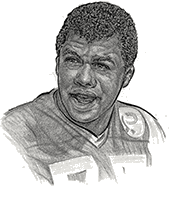
They didn’t come much better in Ohio’s high school football trenches in the Fall of 1972. In fact, no one in the state was better that season in the eyes of the Buckeye State’s sportswriters, who voted the Cleveland Cathedral Latin High prep star Ohio’s High School Lineman of the Year to go along with his national All-American honors. Those honors brought the nation’s premier college coaches scurrying to Cleveland, with Southern California eventually carrying off the prize to Los Angeles. By the third game of his freshman season with the Trojans, Jeter was a starter, an almost unprecedented achievement at USC. In 1975 he was selected to some All-American teams and in 1976 he repeated this time as a consensus first team defensive tackle. In the subsequent NFL draft in 1977, the New Giants tabbed him with the fifth pick of the first round. He went on to play six seasons with the Giants, before returning to California to play six more years with the Los Angeles Rams recording 11 sacks in 1985 and a career high 11½ sacks in 1988, before finishing his career with the New England Patriots in 1989. He subsequently returned to Greater Cleveland where he has made his home in North Royalton and has frequently been heard as a football analyst on Cleveland radio.
Deceased 2016
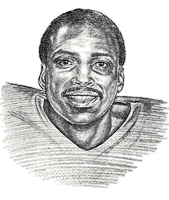
He was a general manager’s dream come true—a first round draft pick who proved to be worthy of the choice. A big, strong running back who plowed through Big Ten defenses with relative ease at Purdue, the Browns tabbed him with their opening pick in the 1976 draft and roundly enjoyed the presence of his company for nine solid season thereafter. The power he displayed in the college ranks continued to evidence itself in the pro game. Four times in five seasons beginning in 1978, he bulled his way to more than 1000 rushing yards, the string only interrupted in 1982, when injuries limited him to nine games. He was a Pro Bowler in 1979 and 1980, an all-AFC selection in 1979 and was picked as the Browns’ Offensive Player of the Year in 1980 and 1981 His 6,450 yards rushing were the third most ever compiled by a Brown, exceeded only by the numbers of Hall-of-Famers Jim Brown and Leroy Kelly. Supplemented by the totals he built in his final two seasons, spilt between Buffalo and Kansas City in 1985 and 1986, his career totals rank him 26th in total rushes, 32nd in rushing and tied for 39th in rushing touchdowns on the NFL’s all-time leaders list. Electing to remain in Cleveland after his playing days, he now lives in Strongsville and is the owner of two auto dealerships, Mike Pruitt Honda, located in Akron, and Mike Pruitt’s Superstore in Lima, OH.
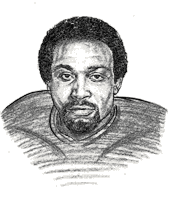
He joined the Cleveland Browns as a second round draft choice in 1973 after a sensational career at the University of Oklahoma where he was a two-time consensus All-American back and runner up in the 1972 Heisman Trophy balloting. It was apparent early-on in his Browns career what the cheering had been about. In his second year with Cleveland he topped the NFC in kickoff returns with a 27.5-yard average, and in his third year he began a string of three consecutive 1,000-yard rushing seasons, missing a fourth by only 40 yards when he was sidelined for four games with an injury. After suffering a severe knee injury in 1979, he was moved into a receiver role coming out of the backfield and in 1981 his 65 pass receptions lad all AFC backs. He was named to the 1973, 1974, 1976, and 1977 Pro Bowl teams during his nine-year career with the browns, which ended when he was traded to the Oakland Raiders for an 11th round draft pick in 1982. His final career rushing totals for Cleveland stood at 5,496 yards, still fourth best of all Browns backs. There was one more good season leading kickoff returner in the AFC and third in the NFL, helping the Raiders to the NFL Championship in Super Bowl XVIII. That earned him a final Pro Bowl appearance, which he celebrated with a record 75-yard punt return. After his career came to a close he came back to the Cleveland area where he has become a successful businessman, currently making his home in Shaker Heights.
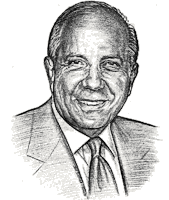
A remarkably successful and generous businessman, this transplanted native of Brooklyn, NY brought to his adopted city of Cleveland, a stunning array of values—humanity, generosity, patriotism, leadership and genuine devotion—which assured his name in a permanent place of honor in the city’s annuals. But, while his unparalleled support of the healthcare and educational communities built a listing legacy, he will, in all likelihood, be remembered best by the city’s legion of football fans as the man who resurrected their beloved Cleveland Browns by purchasing the dormant franchise in September, 1988 for a then-record sum and working with unswerving determination to rebuild both an organizational infrastructure and a team worthy of the Browns’ proud tradition. The process was not without obstacles, but the team seemed headed toward a resumption of its once-familiar role as a perennial playoff team when Mr. Lerner passed away in October, 2002. Dedicating the season to his memory, the Browns provided their popular leader with the most appropriate farewell gift they could muster by powering their way into the playoffs for the first time since their return to the league. Mr. Lerner is survived by his wife, Norma, two sons and seven grandchildren. His oldest son, Randy, succeeded him as president, keeping the quiet Lerner touch in plane with the city’s favorite football team and assuring its continuing presence in the city of its birth.
Deceased 2002