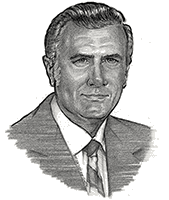
George Chandick’s outstanding 18-year post-college career as a player and player-coach in the Greater Cleveland Basketball League set the tone for a lifetime of devotion and service to athletics in the Greater Cleveland area. A lengthy list of achievements and honors as a coach, official, team sponsor and participant, George embraced a variety of sports, from youth baseball and track and field to horseshoes. His tenure as Council President and later Mayor of Seven Hills, and as a teacher of elementary physical education for 38 years in the Cleveland Public School System enhanced, rather than stemmed, the tide of his activities on behalf of young athletes.
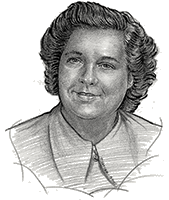
From 1955 to 1985, the road to participation in any City of Cleveland recreational activity for Clevelanders of all ages went through City Hall’s Room 8 and Mary Jane Boldin. As the Cleveland Recreation Department’s Secretary to the Director of Organized Sports, she shouldered the bulk of the day-to-day responsibilities for everything from finding teams for people to join to locating sponsors and funding for those teams. Her efforts in support of Director John S. Nagy were instrumental in the growth of the city’s summer playground Junior Olympics program. She also served with distinction as secretary and/or board member for a myriad of MUNY and AAU programs. In 1986 she was inducted into the Cleveland Men’s Slo-Pitch Hall of Fame.
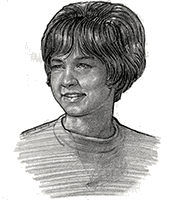
At 16, Jenny Fish Baker was already a world class women’s speed skater. Thus her selection to the 1968 U.S. Olympic Team as a Baldwin-Wallace College freshman was no surprise. Nor was it a surprise when she earned Olympic Silver in the 500 meter sprint at Grenoble, France. She began her glide to the Olympics in 1961 at the age of 12, winning the Ohio indoor championship and the Cleveland Press Silver Skates Midget-Novice title. She repeated in the Juvenile division the next year, adding the Ohio outdoor championship. In 1964 she won Ohio and National indoor and outdoor Junior championships, then added the U.S. National Open indoor and outdoor titles. She won the Junior Division indoor and outdoor championships again in 1965 and in 1966 she became the U.S. National Intermediate Champion indoors and outdoors.
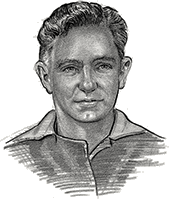
A Pennsylvanian who moved to Cleveland to play for the American Hungarian team, George Caraffi and his brother Ralph were the city’s best soccer players of the 1920’s. Originally a defender/midfielder, he gained his greatest fame as a center forward. He twice scored seven goals in a game, but his biggest goal came on June 23, 1929; the winning goal against Hakoah of New York, the U.S. National Champions. In the Western finals of the 1928 National Challenge Cup, he scored two overtime goals in a 4-1 victory and the clinching goal in a 2-1 win in early rounds, and the goal which gave his team a short 3-2 lead in overtime of the finals.
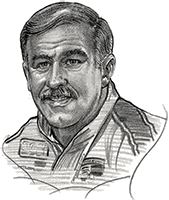
From August 1972 through October 1990, Frederick Baker drove in 184 races, winning 88, placing second in 30 and third in 18. During his memorable career he qualified for the pole position 69 times and established 25 lap records. In 1980 he earned acclaim as the worldwide Jaguar Driver of the Year and also earned C Production National Champion laurels. He placed seventh in the 1989 international Porsche Turbo Cup Invitational held in Kylami, South Africa. Closer to home, he three times won the famed Nelson Ledges 24-Hour Endurance Race.
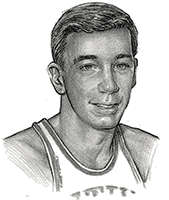
One of the most prolific scorers in Cleveland high school basketball annals, Phil Argento astounded fans with a 66-point outburst against Cleveland South in 1964. He played for Cleveland West High from 1962 through 1965, twice winning all-scholastic honors. Phil went on to play at the University of Kentucky for fabled coach Adolph Rupp from 1967-1969. He became a starter as a sophomore and captained the Wildcats as a senior. Drafted by the Los Angeles Lakers, he played instead in the National Amateur Basketball League for five seasons and later became a high school coach.
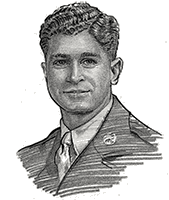
Armand D’Anna starred in Greater Cleveland’s strong Class A amateur baseball program over parts of three decades, pitching in 17 national tournaments and starting for famed Rosenblums in the first amateur night game at Cleveland Stadium. He began his amateur career in 1936 fresh out of Shaw High, pitching for the Class A champion Fisher Foods team. After playing pro baseball for two years, he returned to pitch for Fisher Foods, Factory Furniture and Rosenblums from 1940 to 1952 with a four year time out for World War II service. He also coached Rosenblums for three years and was a head coach for 27 years in the Euclid Boy’s League.
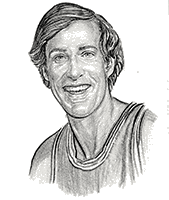
Rarely does a Division III basketball player make it to the NBA. Barry Clemens not only made it, but carved out an 11-year career, including two seasons, 1972-73 and 1973-74, with the Cavaliers. Clemens was born in Dayton and grew up on a 200-acre farm in Xenia, Ohio. At Xenia High School, where he graduated as the Salutatorian in 1961, Clemens starred in basketball while also running track and cross country. Recruited by numerous Division I colleges, including Ohio State and Ohio University, he instead chose to attend Division III Ohio Wesleyan. In four seasons at OWU, Clemens finished as the school’s and Ohio Athletic Conference’s career leader in scoring, leading the Battling Bishops to a 71-23 record. His career high at OWU of 41 points came against Baldwin-Wallace in January 1965. The New York Knicks made Clemens, a 6-6 forward, the 19th pick of the 1965 NBA draft. It was a draft that also included Bill Bradley, Rick Barry, Walt Frazier and Billy Cunningham. In 11 seasons with five teams, used primarily as a reserve noted for his deadly perimeter shooting, Clemens averaged 6.7 points and 3.2 rebounds. Today, he is Managing Director for Wachovia Securities and lives in a Cleveland western suburb with Vivian, his wife of 42 years. They are the parents of three children: Justin, Jennifer and Matthew.
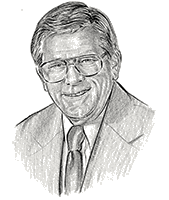
You have seen Bobby Brown hundreds of times over the years. But you never noticed him, and that’s just how he liked it. Involved in basketball and football officiating for half century, all Brown wanted everyone to know was that the call on the floor or field was the right one. It nearly always was just that. After attending Rhodes High, Baldwin Wallace College and a Captain’s tour with the U.S. Army Air Corps in World War II, Brown settled down with his wife Dorothy in Parma. He began officiating basketball and football games in 1948 and never stopped. He spent 33 years working football games, 24 at the collegiate level. He was president of the International Association of Approved Basketball Officials-Board No. 55 in 1959-60. Besides 25 sectional, 23 district and 18 regional high school tournaments, he refereed three state football championships. In Cleveland, he officiated 14 city championship basketball games and 12 football title games. He has been a high school basketball rules interpreter and spent 24 seasons as an observer for the Ohio Athletic Conference football officials and 24 as Cleveland State’s basketball observer. Somehow he found time to serve terms as the Parma School Board President in the 1960’s and head the Cleveland Touchdown Club in the 1980’s. Numerous awards have come Brown’s way over the years for his steadfast dedication and unassuming dignity. At age 90, he adds this latest honor in his typical humble fashion. It’s the right call once again.
Deceased.
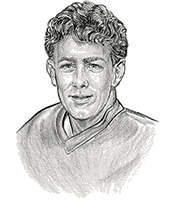
A 5-foot-9, 178-pound wide receiver willing to go over the middle to catch a pass in the National Football League is one tough customer. Brian Brennan did it for nine seasons, eight of them with the Browns. Whatever Brennan lacked in size, he more than made up for it in courage. Brennan caught the attention of NFL scouts in the early 1980’s when he was on the receiving end of passes thrown by heralded Boston College quarterback Doug Flutie. He holds the single-season BC record for catches (66) in 1984. The Browns made Brennan a fourth-round selection (104th pick overall) in the 1984 draft, and it turned out to be one of the great fourth-round picks in franchise history. In eight seasons with the Browns (1984-91), Brennan had 315 catches (currently tied for fourth in club history), with 20 touchdowns. Brennan’s best season with the Browns was in 1986, when he made 55 catches for 838 yards and six TD’s. One of the most memorable TD grabs Brennan made occurred in the AFC Championship game against Denver in January 1987. Brennan’s 48-yard catch from Bernie Kosar gave the Browns a 20-13 lead with 5:43 left in the fourth quarter. The Cleveland Stadium crowd smelled the Browns first Super Bowl appearance. Alas, it never happened. What unfolded instead was “The Drive”, John Elway’s 98-yard march that ended with a touchdown, after which the Browns went on to lose in overtime. Brennan, whose career ended with the Bengals and Chargers in 1992, had 334 receptions during his career for 4,338 yards and 20 TDs in 132 NFL games. Married to wife Bethany, Brennan is an executive for KeyBank Corporation and has served as the Director of Football Operations at Gilmour Academy.